

Art is supposed to be subjective. Yet, in every creative discipline arbitrary rules bind the hands of professionals as they forge their works.
In film, some of these easily recognizable constraints include run time and format. On the surface, these forward facing details seem like innocent indicators to help moviegoers prepare for a theater visit. Even premiere priced viewing options such as IMAX, Dolby, 4D, or even cinema specific-options like Laser and XL at AMC cleverly sell audiences a false sense of control. But long before a flick hits the silver screen, decisions surrounding other narrative elements set a cinematic course most screenwriters have trouble deviating from.
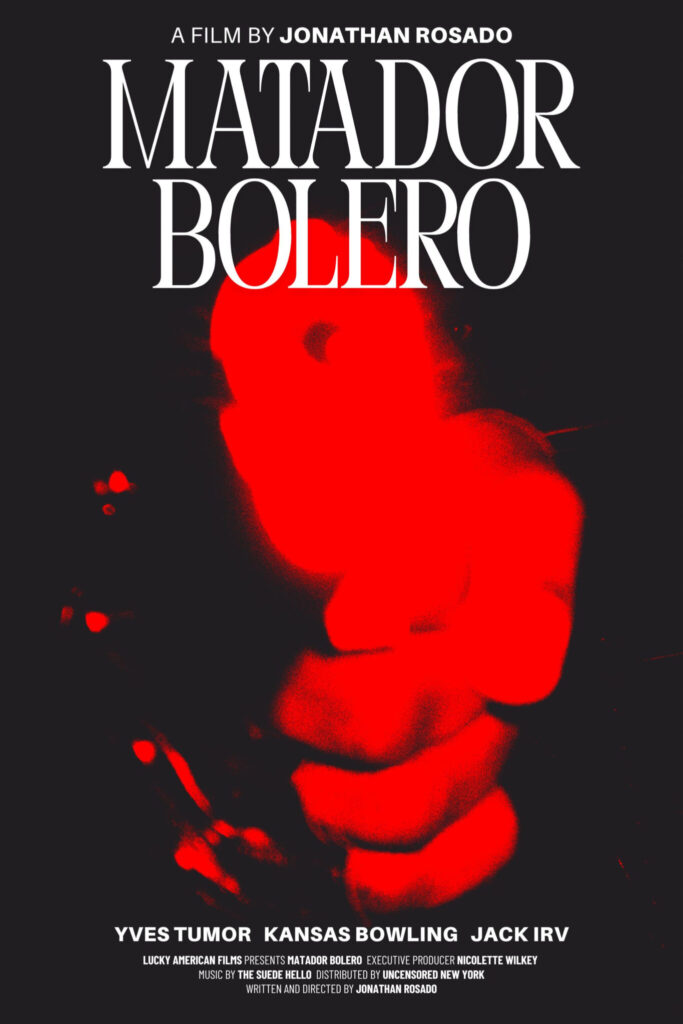
While the three-act structure, which follows a plot setup, then tumultuous climax, and tale’s ultimate resolve, is regarded as the professional formatting standard, it has churned out a sea of neatly predictable pieces. Composer, director, and screenwriter Jonathan Rosado’s filmography is here to challenge the standardization of cinema—especially his latest film, Matador Bolero.
Months after the film’s limited run screening tour, Rosado hooped onto a Zoom call with me to discuss Matador Bolero, which stars Yves Tumor and Kansas Bowling, as well his overall artistic mission. Perched against kaleidoscopic tapestry, with a beaming smile and a head full of effortless waves nearing his shoulder, you’d be hard pressed to view Rosado as a disruptor. The director’s demeanor leaned more free spirit than table shaker. However as he began to speak it was evident Rosado was not much of a rule follower.
With Matador Bolero marking his third independently released feature length film, Rosado admits the achievement still “feels weird.” Honestly speaking, the professional world of film wasn’t something Rosado even briefly considered.
“This wasn’t really the game plan for me to make three films in five years,” confessed Rosado. “It kind of just kept happening. Sort of weird, but yeah, now I have my own little filmography going.”
And that he does. Rosado’s directorial debut Viridian Hue was shared in 2023 and was quickly followed up the following year with Brutalist Couture. Then, thanks to his musical partnership with The Suede Hello group mate, Nicolette Wilkey, a two-year exploration blossomed into their latest avant-garde picture, Matador Bolero.
Once Rosado scratched his first film itch it was hard to stop it from snowballing into something larger than himself.
“My bingo board was like, become Jimi Hendrix or Led Zeppelin. That was, like, my thing,” admitted Rosado. “When I first started doing movies, it wasn’t with the intention of anyone ever seeing anything that I was making. The first film I made was supposed to be a break from the other things I was doing that I was more serious about, like things in the realm of music.”
After deep thought he added, “I kind of wanted to just stay artistic, but, take my mind off of the idea of it being commercially successful by just doing some side thing. And then that ended up being kind of what other people took to more. [So] I kind of slowly got more involved with it that way.”
With the “director” label now branded to his chest, Rosado has accepted his visual projects should be as expansive as his music. Free from the industry conditioning or institutional indoctrination other filmmakers fight their careers to break from, Rosado only crafts what he himself finds interesting. Rosado is not interested if it adheres to standard visual palates, common storytelling patterns, or refined plot points. Still, despite his resistance to film familiarity, Rosado is on the fence about being considered a “disruptor.”
“It wasn’t really intentional, I wouldn’t say. [But] I do agree with your assessment,” Rosado interjected. “Maybe me coming from an outside perspective and not really knowing that much even about movies or what was considered right or wrong to do or something—maybe made me approach things with more reverence towards tradition.”
He continued, “So I guess it comes off as this super transgressive thing, but really I was just trying to do something that I thought was fun and cool and interesting.”
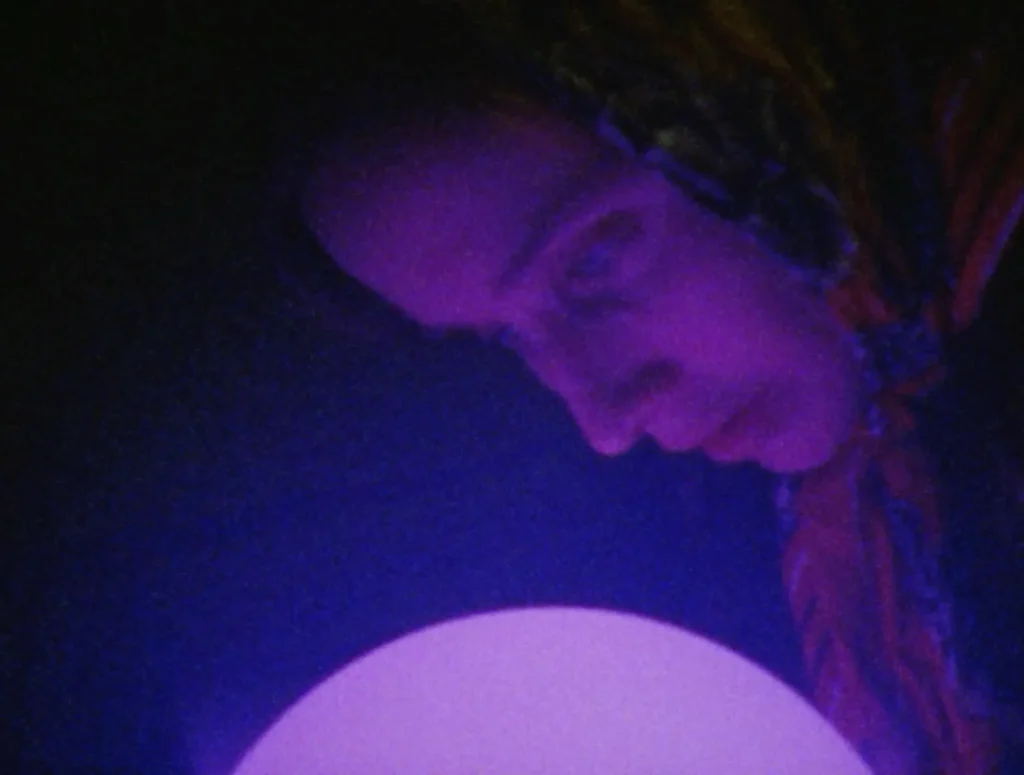
One thing Rosado finds particularly interesting or so his budding filmography shows is life as defined during different time periods. Although his past works drew inspiration from the 1960s, in Matador Bolero, Rosado lifted from the 1970s.
“That period of life romanticized the idea of what culture is—at least in this country,” declared Rosado. “It seems to be upheld somehow as, like, the golden age of everything in a way. The art from that era and the movies, music, and everything just kind of has this strange glaze of optimism and American idealism that I think is interesting to contrast with how the world is actually now—how it actually all played out.”
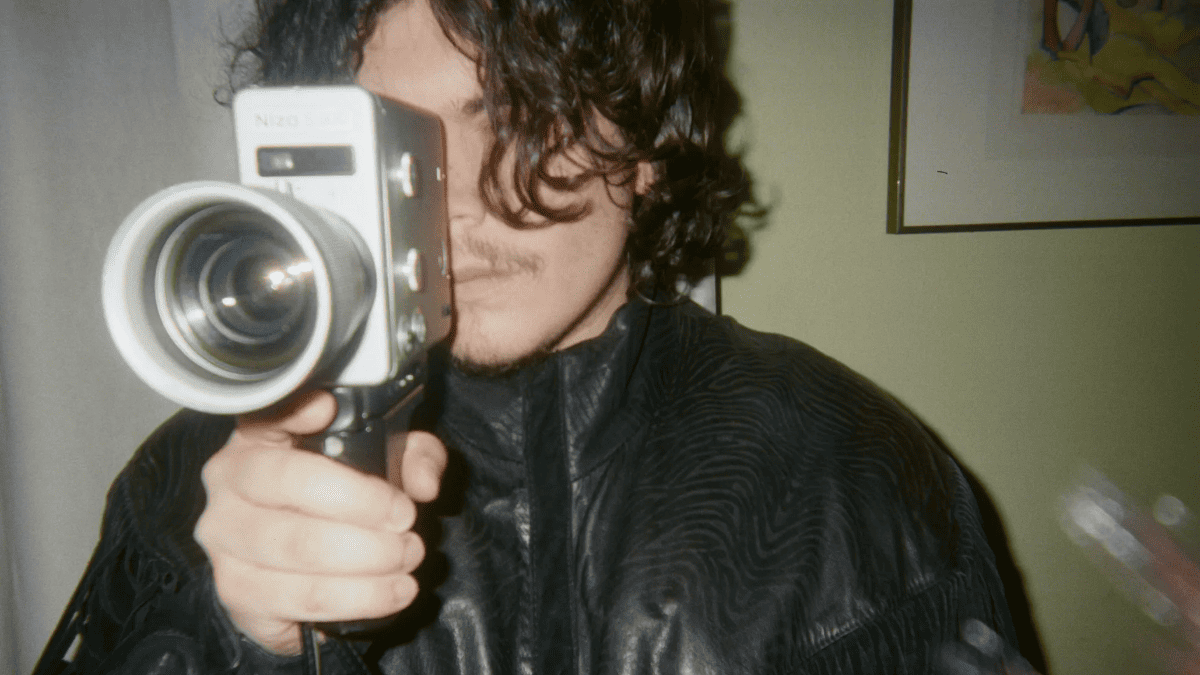
Rosado’s works are not linear. Nor is it formulaic. Still, every director has a signature. For Rosado that’s none other than the Super 8mm film camera. In recent years, film technology has taken center stage. Oscar Award-winning director Christopher Nolan continues to push the bounds of IMAX. Just this year, Nolan’s epic Odyssey became the first film to be shot entirely on IMAX cameras. Whereas the Oscar Award-winning picture, Sinners by Ryan Coogler brought a spotlight to IMAX 70mm. Sometimes a more readily available option fits more with a director’s vision. Danny Boyle’s 28 Years Later was partly filmed with iPhones. As for Matador Bolero, Rosado decided on Super 8mm because in his words, it just “has a classic or traditional appeal to it.”
“Everything’s shot on digital now because everyone’s on their phone and stuff,” Rosado scuffed. “So it’s just a little bit less special to me maybe than seeing something on film, which you don’t necessarily see every day when you go on, you know, Instagram or whatever it is.”
Although Rosado’s preference is steeped in traditionalism there’s a secondary modern mindset to his commitment to Super 8mm.
“The other thing is, within the realm of film, I just really like how light and, like, accessible Super 8 is,” Rosado admitted. “The cameras are super easy to use. They weigh nothing. I don’t have to carry around a bunch of equipment all the time and take forever to set up cameras and stuff.”
He continued, “Whenever I see behind-the-scenes stuff of people with a huge camera on their shoulder and everything like, six monitors and a headpiece, I’m like, ‘Oh, my God, I don’t want any part of that nightmare.’”
This ease of mobility granted Rosado the ability to immerse himself in expanding Matador Bolero’s visual story. Timeline jumps, long periods of silence, and trippy patches of choreography may read more performance art than film. Or is it that onscreen storytelling has simply lost its veil of whimsy? Yes, average moviegoers can find it to be overwhelmingly abstract. But that’s the point–at least for Rosado.
The film’s official plot reads: “A high-profile murder in a New York nightclub draws the attention of an obsessive detective, a TV news reporter, and an elusive being living outside the realms of time and space.”
However, after powering through your first watch you could summarize it as a game of clue on an acid trip. As the plot unfolds, viewers realize that this story isn’t something you can engage with passively. Every detail matters. Filled with oververt symbolism, protracted subplots, and even meticulously hidden themes, Matador Bolero challenges onlookers to gather their own conclusion. Spoonfeeding the story isn’t a menu option. Instead, watchers are forced to enjoy the ride without care for a tidy endpoint.
“I like to use the story as a vehicle sort of to explore,” said Rosado while describing the approach he took when screenwriting Matador Bolero. “I always like to use the example of ‘2001: A Space Odyssey.’ There is a story. But it’s also not really about the story necessarily.”
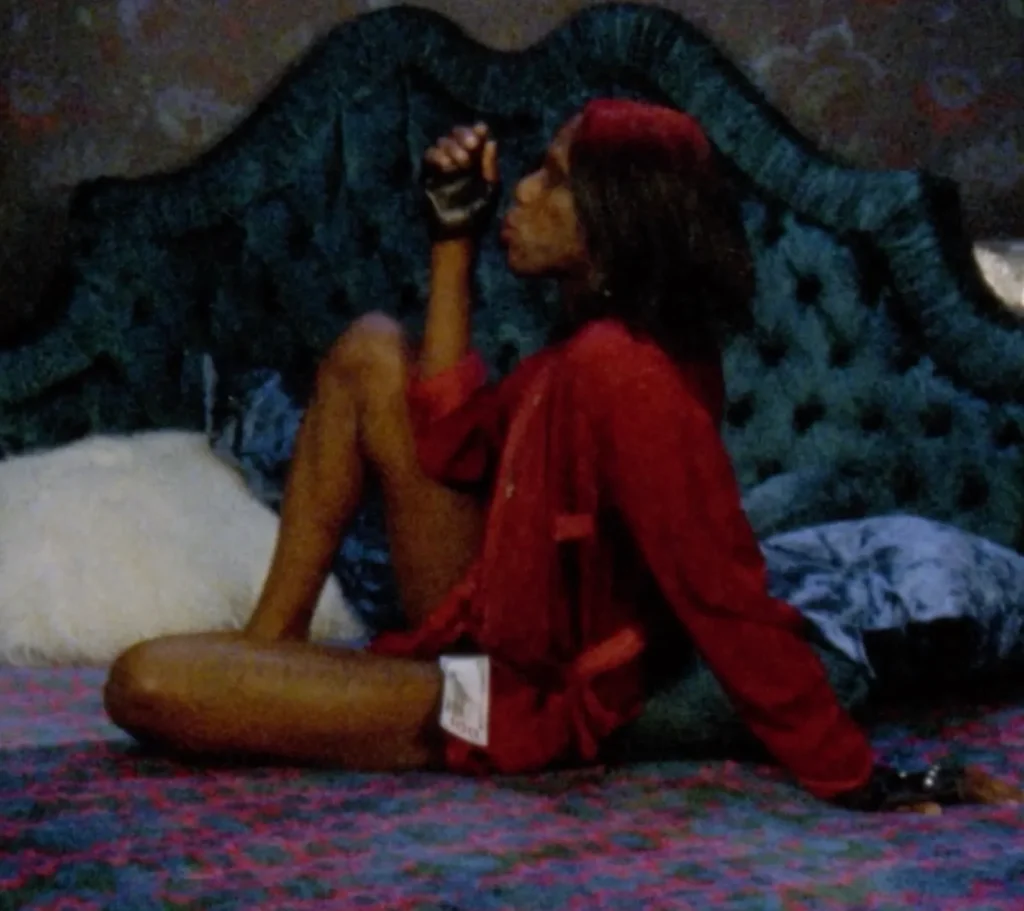
This fluidity was crucial to the casting of Matador Bolero which led to musician Yves Tumor’s involvement. The alternative musician and producer’s artistic persona could not have been more aligned for a film. Yet, Rosado and Wilkey were doubtful that Tumor would be willing to sign onto the project as their acting debut.
“Me and my producer emailed Yves’ manager, and we didn’t really expect that he would actually respond or be interested,” Rosado shared. “We thought if there was any response, it would certainly be a no.”
He continued, “But we laid out the plot of the movie, and talked about how it was shot on Super 8 and, [how it] wasn’t going to be a conventional movie. It wasn’t going to be super narrative-driven. Even though there is a story, it was going to be more about themes and things like that. So we basically pitched him the movie over email. And then, to our amazement, he agreed to be in it.”
As filming began, the trio fell completely in sync.
“The first time I met him was when he arrived on set. I didn’t know I didn’t have any prior relationship,” Rosado said. “But, yeah, I thought I think he, like, fits perfectly into the world somehow and, like, the character and everything. It just seemed like a perfect fit.”
Rosado is concise that this isn’t always going to be the case.
“I think with my work, obviously, it’s more experimental than, you know, most of the other stuff that’s in theaters,” Rosado chimed. “So I wouldn’t say that my ideas wouldn’t be a problem so much as maybe people could just accept that maybe they didn’t understand things as well and that that’s OK. And it could still be enjoyable either way.”
He went on to draw the comparison to other art forms.
“Sometimes you hear a song, and you’re not really sure what it’s about,” Rosado remarked. “Or maybe it doesn’t even have any lyrics, just instrumental or something. But you still get a feeling for what the author of that was trying to express. Whatever emotion it was, or if there are lyrics, but the lyrics seem to be sort of very abstract and stuff. You could still get an idea for what mood or atmosphere or feeling they were trying to convey. So I would like people to see films in a similar way.”
Due to Matador Bolero’s stuffed symbolism, Rosado is hard pressed to commit to one point of inspiration for the film.
“I think my real inspiration was just wanting to make something about artificial intelligence. How technology is taking over everyday life and we’re sort of also slowly seeming to be merging with technology or being pushed in that direction,” Rosado replied.
As for the cultural commentary presented in Matador Bolero, Rosado wanted to examine American’s obsession with celebrity.
“[Viewers follow] a famous young Hollywood actress being killed at a nightclub because I saw that as, like, the death of the old romanticized Americana world,” Rosado remarked. “She’s almost like a Shirley Temple type.”
Other themes such as “petty human desires” and rebirth serve as a common thread throughout the picture. Rosado is not fixated on whether or not it clicks the viewers in the moment. Instead, his goal is to push “audiences to consider more.”
“I would encourage people to think more about what certain key pieces of the plot early on could suggest metaphorically for the rest of the movie,” Rosado put sternly. “Like, we were kind of talking about the girl dying. What could she represent? What do the eggs represent? What is this world that the computer seems to be building?”
In Jonathan Rosado’s world, the audience decides what they walk from a piece with.
Do you want more of Jonathan Rosado? Stay connected with The Suede Hello on Instagram or their official website, here.