
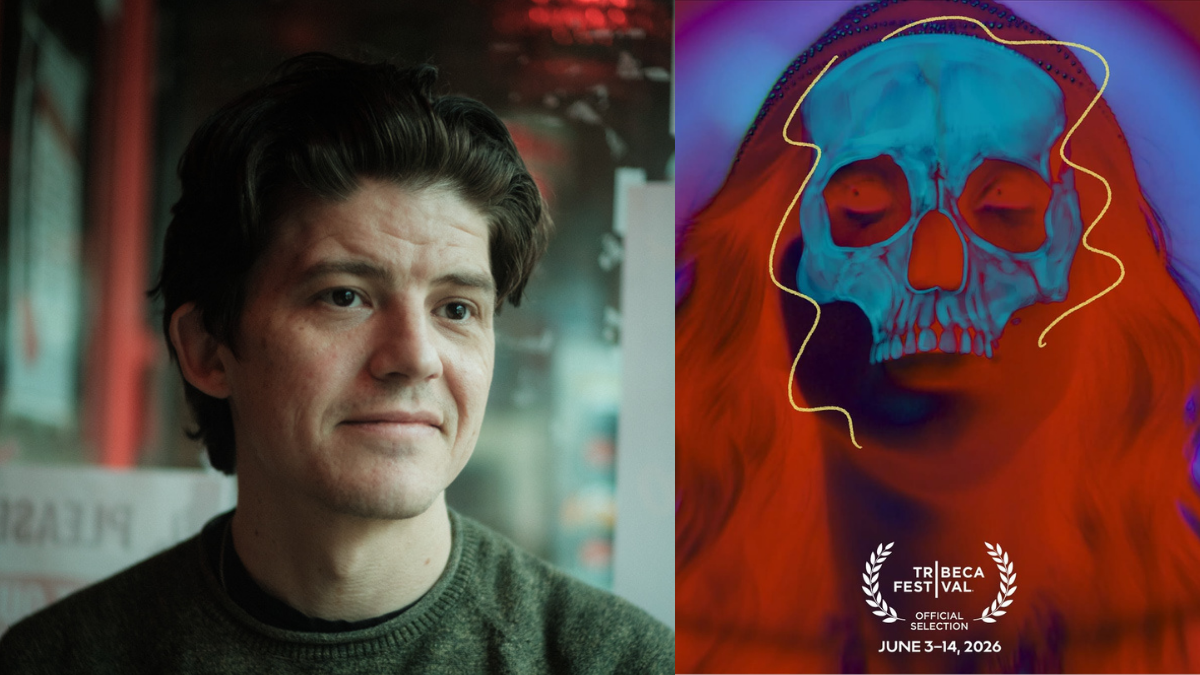

The music business is not a real place. To those glancing in from the outside, this statement seems grossly hyperbolic. However, industry insiders’ lived experiences prove this belief to be empirical. Buzzing Canadian filmmaker Sam Scott’s new feature film, Turn It Up! (Yellow Veil Pictures) poetically captures the warped nature of it all.
The sci-fi horror, which stars Justine Nelson, Gwenlyn Cumyn, and Julian Richings with cameos from the band A Primitive Evolution, takes these ‘guess what happened at work today’ tales you whisper to your friends and wraps them in witty humor sprinkled with a dash of audio theory. As the onscreen budding rockers navigate professional highs and lows, they stumble upon a nearly fatal riff that could take them to new heights. However, not every sweet lick is worth strumming.
Ahead of the movie’s world premiere at the 2026 Tribeca Film Festival, I caught up with Scott. During our conversation, we discussed his comedic spin on audio theory, mixed media approach to cinematography, working with the bands A Primitive Evolution & Ace Of Wands, the greatest riffs of all time, and more. Read the full chat below.
First and foremost, congratulations on your feature directorial debut! You’re coming off of 2021’s feature documentary, Beams. You’ve done a bunch of shorts. But to have your feature narrative debut at the Tribeca Film Festival is just wow. Can you tell me what that means to you as a director and filmmaker?
“I am still kind of learning what it all means. You know? Even questions like that, I’m kind of like, ‘I guess it means a lot.’ I’m aware of the ecosystem, but also I think I had just been operating in such a …it’s such a niche movie, and it’s so absurd and weird that I didn’t expect this at all.
I think every filmmaker hopes their film will be shown at a Tier A film festival.
[…] I just didn’t expect this because [Turn It Up] is so weird, so Canadian, indie, and a goofy horror movie. I just didn’t think, like, ‘Oh yeah, Tribeca is a part of the plan.’ Absolutely we’ve got to aim for Tribeca. So the fact that it has happened is like a weird, wonderful dream. It’s made me very, very, very nervous. I hope in a good way. But I want to say it’s been a whirlwind. But I found out months ago [premiering at Tribeca], so I’ve had a really long runway to think a lot about it. And I’m just really excited to go. I’ve never been to Tribeca before.
So, everyone is asking about how I feel; I guess the answer is I’m just a little shell-shocked.”
I mean, it’s only natural. And it’s ironic because you’re running in tandem with the character in your film. It’s like everything the world is changing around them, and they’re trying to figure it out as they go along. And it seems like you may have been your muse.
But let’s talk about the actual muse so far in your career. You have done quite a lot of work, whether production, writing, or directing. With Turn It Up, we see, or at least we’re forming a consensus around, your art, and music is a huge muse for you. What was it about this particular script?
There are secret societies, off-book government agencies, betrayal, tension, and love. What was it about this script that made you say, ‘Okay, I’m going to take this from page to screen?’
“I mean, the callous answer is this is the one that the producers went, ‘We want that one.’ And so, it is partly a lesson, I think, for independent artists too. Work within, sort of, you know, like, go where the ideas chase you. But also, if there are other people with the money who want to give you the money for ideas, those ideas will get changed and tweaked. And the important part is to take your own experiences and just throw them in there.
So I never set out to write this going, like, ‘I’m going to write this movie and have it be, like, I’m going to pitch it around, and I’m going to because this is the story I need to tell.’ It was actually I got tapped to make a movie. I pitched some concepts. This is the one that the producers went with. I had already had a script, but I rewrote it with my partner, Gwen[lyn Cumyn]. We went through it to decide which of the personal experiences I wanted to tell in it. And I think it really was, like, the whole movie’s a lot of goofy nonsense.
But the core of it, I think, is the idea that I reached an age where I was in bands, and then I kind of stopped playing in bands. That feeling is kind of when you have to maybe sort of grow up, but also it’s maybe accepting it or realizing that, like, I’m in this band so I can hang out with these people. Maybe we’re just friends now. And a lot of movies about music are sort of, like, about, like, ‘Well, you got to keep the band together.’ And it was sort of something like, while I was making it, I wanted it to be like, ‘Yeah, the band’s important, but, like, you don’t learn the band’s name.’ You never really hear one of their songs. It’s not about the band.
So it is my personal experience of playing shows and going to weird small towns and it being empty and in the weirdest venues, and you do feel like maybe something weird is going on. But then also I’m obsessed with funny secret societies and conspiracy theories, and I love just putting that stuff in. I said before I wanted the movie to feel like a cavalcade of nonsense.”
No, I love it. I think it just kind of shows so many layers. And that was one of the questions that I had. There are so many things to take away from this film. There are so many themes, whether it’s behind-the-scenes industry things or, like, this perspective from a band. There are so many things to pull. And for you to say, this is what I want people to walk away from. I find that very interesting.
Obviously, there is science fiction and horror, but the humor cannot be undervalued in this particular film. So can we talk about it? As a music journalist, primarily, some of the themes that I found hilarious are when we talk about hydroponic sounds, psychoacoustics, and the loudness wars. These are debates for audio engineers and really astute music lovers. What was it during the research process that you found interesting or even, said, ‘Okay, I’m going to put a a humorous spin to this?’
“There is a part near the end where Court (played by Gwen), one of the co-writers’ character says, ‘How you can change a particle just by looking at it.’ But with sound, which is like a weird audio theory. So there’s, like, something in physics where, if you look at a particle, it changes how the particle acts as though it knows it’s being looked at.
And that was something that always stuck with me as, like, ‘Whoa, that’s weird.’ And I kind of was like, ‘Okay, well, just apply that to, like, sound instead of looking.’ Like, what if a particle knew it was being listened to? It was just one of those things that would be like, ‘Ooh, there, that’s fun.’ You know, when you’re, like, you have a little idea and you don’t really know what to do with it, but you’re kind of like, “Oh, that would be scary or cool.’
As an audio person in general, that was the thing that was the most, like, tantalizing about it. And then obviously, the script goes in a bajillion different directions and kind of gets far away from the science of that.”
Well, I mean, you already know this is going to start a debate amongst the audio professional communities. So many people are going to say, ‘Well, technically this.’ Or, ‘You know what, that is actually something that we need to research.’ You’re probably going to be responsible for funding a whole bunch of research at some university.
Another thing I found very tantalizing about this particular film is the mixture of cinematography styles. So obviously, with this being a mix between horror and sci-fi, you have those very quintessential suspense shots. You have those very innate gore shots, right?
But the interjection of visual effects is so stimulating. What was the conversation between you, Anne [Douris], and Kenny [Ken MacLaughlin] going into this? To say, “Okay, like, when are we going to pull back a little bit to keep this balance, or when should we break away from the norm?’”
“I mean, it started with Kenny, who I’ve worked with on a few films as a producer before this. And so we already had a rapport. And so we had, like, a lot of time to sort of, like, sit across from him. We live in the same neighborhood and are like, ‘I see this. This shot is important. I have an image in my brain of this.’ And then there were, like, other parts where I would say, like, ‘Kenny, I have no idea what this looks like, but it’s not really on script.’ And he was really good at it even on the day, if I had something in my mind being like, ‘Well, actually, ‘and he would give me a justification that was, like, really related to the script. He very much cared about the story and what was happening. So he would say, ‘This shot should be 20 degrees this way because of the feeling it will evoke,’ which is just, like, a language that works really well. Kenny is an artist. He’s tender, and he cares. He’s got empathy for the screen and what’s happening.
Anne, I’ve worked with many times. I was in a band with Anne back in the day. Like, we know each other, like, old-school friends. I had ideas that were in the script that I hadn’t fully decided what was going to be animated or VFX, but I threw to Anne and sort of said, like, ‘What can I get for that, and what would that cost?’ And then it sort of went from there.
Like, once, then we shot, knowing there’d be, like, a couple of animated bits. And then when we were in editing, I sort of gave Anne another pass where we just sort of said, like, ‘Watch it, and if you think of anything or want to add anything,’ or even, like, the opening bit of animation wasn’t in the original script or concept. It was just wanting the beginning to, like, punch out a lot more. I think I had, like, watched Eraserhead or something dumb, like, the night before and gone like, ‘Oh, actually, this movie should begin with, like, 15 seconds of, like, total bizarre weirdness so the audience is completely off-footed.’
But Anne is, like, an incredible collaborator, so very gracious and willing. And when I go like, ‘Hey, can we do a little bit more animation?’ She was always like, ‘Yep. Yes, we can.’ And Kenny was similar because Kenny was with me all the way through. So, having those two people all the way to the end and James [Anthony Young], the VFX artist who was collaborating on it as well. His work was a little more, like, straightforward, and it was great, but he was doing like, 600 VFX shots in this thing, but a lot of them are prescribed in the script. He brought a lot of cool creativity to the visuals as well.
I’m really pleased with how it looks. Considering for, like, two years while we were making it, there was a lot of people who would read the script and be like, ‘There’s no way you’re going to be able to make this.’”
And you proved them wrong.
“And I would be like, ‘Well, no. You know, you just get a little bit of animation in there. Smooth it out.’ Um, and yeah, so thank you. I really appreciate you calling out, uh, the visuals. It just lets me talk about these people who so far in this thing I haven’t gotten to mention in any of these press interviews yet, Anne and Kenny, two of my favorite people.”
No, I think it’s important just because, as art, I think in the, I guess, past couple of seasons of cinema, if you will, we’ve started to see the audience become interested or in desperate search of a fresh perspective. Film lovers want changes. They want variation. And I think mixed media is that next front. And ‘Turn It ‘Up’—I think this is what I envisioned.
There are some hints of familiarity, but there are other hints of, like, “Oh, I didn’t expect that, but this adds so much to the storytelling.” And I’m so glad it’s there. So, even if no one else has mentioned it. I, at least, as a viewer, am glad it’s there.
“You get all the points. Yeah.”
Thank you. Speaking of collaborators, one thing that I couldn’t help but notice as a music nerd myself is there are several, and I counted, I think, half a dozen, and I probably missed some, but there are Easter eggs of Canadian musicians’ names or, like, references to them throughout the script.
Yep.
Kudos to you. I thought that was hilarious. So can we first mention how you sneaked that in? Did you find it as a game with the other writers say, ‘Okay, how are we going to get this in here without being cheesy?’
“There were a few conversations about who we could reference and have it make sense. And occasionally, some people who, you know, won’t be named would say, like, ‘Can you really, should we really be referencing that band? Is anyone going to know what that means?’ And I kind of defended it in a like, one, the person still watching this movie will know who Sum 41 is. But, like, also, you know that it’s a band. If the person doesn’t understand yeah, like, you calling it an Easter egg is actually great.
I didn’t see it as me trying to pack the movie full of all these Canadian references. These are bands that I either know or listen to or just think it’s funny to bring up. There’s just something funny about mentioning Len or Nickelback, not even making fun of them, just saying they exist. I don’t know why it’s kind of funny.”
I mean, I quote Shania Twain all the time. So for me, a ‘Let’s go, girls’ line that’s just makes sense.
“Thank you for getting that one.”
Speaking of, like, musicians, I think the score is really important, especially for a movie about music and about bands and band life. So, can you talk to me about the decision to tap A Primitive Evolution and Ace of Wands?
“Yeah. The score is Adrian Ellis. The band’s songs in the movie are Ace of Wands. And then the other band that is in the movie that is in a couple of scenes is Primitive Evolution. It started with me just wanting to work with Ace of Wands because Lee [Rose] from Ace of Wands is one of my [longtime] collaborators. For 20 years, I’ve been collaborating with her. I’ve been in a bunch of bands with her.
I knew we needed music that would be, like, shown on screen. And I wanted to try and tread this line of, like, playing some music that would, like, seem like maybe it was the music from the band, but it’s never really shown to be.
The song in the movie is played by Ace of Wands. But Adrian Ellis, the composer, wrote the melody. And it’s like the melody from the score just given to the band. And from moment one with Adrian, one of the things that, like, we didn’t want was the score to the movie to be a rock and roll score.
Like, I was very, like, straightforward. ‘Ghostbusters.’ Over-the-top science fiction score: get as spacey as you want. And then Adrian was like, ‘I’m going to put theremin in it.’ And I was like, ‘Yes, you are.’ But he was crucial to the rock part of it as well and worked with Ace of Wands. And that, to me, was great too because I just got to watch all these people who I know and I respect cook.
And that was like, I’m learning a lot of lessons, sort of similar to Anne and Kenny, where it’s like a movie like this, you kind of need to, like, trust all your departments. I could not micromanage the score or the music. It’s, like, too complicated and big. But the fact that Adrian was so great and committed and knocked it out of the park. Ace of Wands, I just already knew, was amazing.
They were putting out their new album. They had just finished it while I was going into the mix and so had access to all of these tracks that weren’t out yet. That’s why there are six or seven tracks. And then it was only after the fact that Primitive Evolution was in the movie and played the band in the movie that I was like, ‘Oh, well, we’ve got to get Primitive Evolution songs.’ And it just then so happened that I was like, ‘Oh, wow. Well, this song actually works as the thematic thing for this piece of technology.’ And so it just sort of follows the flow of all these artists that were floating around the project already and just being like, ‘You,” rather than going out and being like, ‘Here’s what I want.’ That was the biggest lesson with the music. Let them drive along with me rather than try and, like, steer it too hard.”
And obviously, we the viewers are following from start to finish the band chasing after this riff, right? This intoxicating, almost deadly riff, right? So my last question to you, because the movie’s about riffs, what are your top three riffs of all time?
“Oh, that’s a hard question. My goodness. Okay. Oh, Pixies’ Where Is My Mind.”
Ooh, that’s a good one.
“Weezer’s The Sweater Song.”
Okay.
“Probably a Beatles one. I’m thinking of ones I just play absentmindedly on the guitar when I’m holding it, just, like, randomly to, like, pass the time. But I currently can only summon two.”
No, I get it. When I was thinking about this, I had to make a list for myself. So if it makes you feel any better.
“Yeah, I would like to hear yours.”
Okay. So, I have eight, but my tops were Iron Man by Black Sabbath.
“Yes.”
My other one was Walk This Way by Aerosmith and then Enter the Sandman by Metallica.
“Enter Sandman’s great one. That’s one that I will just be standing there with my guitar, killing time. Very fun to play. I’m going to add that that’s going to be my third.”
Okay. You could borrow mine.
“Thank you.”
Thank you so much for taking the time out to chat with me. I truly do appreciate it. And I’m wishing you nothing but success with this film. I thoroughly enjoyed it, and I know audiences will as well.
“Thank you so much for your attentive questions. It was really, really great.”
You can catch one of the screenings of Sam Scott’s Turn It Up! at the 2026 Tribeca Film Festival. Turn It Up!’s show times are set for June 4, 2026, beginning at 8:30 p.m. at AMC 19th St. East 6, June 5, 2026, beginning at 8:45 p.m. at AMC 19th St. East 6, and June 7, 2026, beginning at 9:15 p.m. at AMC 19th St. East 6. The AMC 19th St. East 6 is located at 890 Broadway in New York City, New York. Click here to grab tickets.
The 2026 Tribeca Film Festival will take place between June 3 and 14, 2026, at various locations across New York City. Click here to view this year’s screening and programming schedule. Read our full coverage of the 2026 Tribeca Film Festival here.